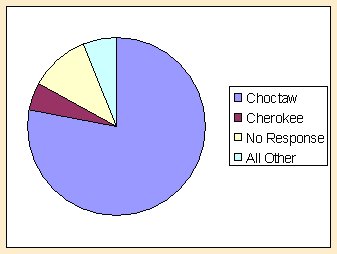
The following is a summary of the CRIMES community needs assessment administered at the 2003 Choctaw Labor Day Festival. A total of 410 Native Americans living in the ten and a half county area of the Choctaw Nation completed this survey.
| Gender: |
18 % - Male |
79 % - Female |
No response - 16% |
| Age Range: |
18-30 = 22% |
31-40 = 26% |
41-50 = 23% |
| |
51-65 = 18% |
65+ = 6% |
No Response = 4% |
| Tribal Membership: |
Native American - 100% |
|
| Choctaw - 78% |
Cherokee - 5.2% |
Chickasaw - 1.9% |
| Creek - 1.6% |
Lumbee - 2% |
Cheyenne/Arapaho - 0.5% |
| Pottowatomie - 0.7% |
Lakota Sioux - 0.5% |
Otoe-Missouri - 0.2% |
| Seminole - 0.5% |
Fort Sill Apache - 0.2% |
Comanche - 0.2% |
| Otoe-Missouri - 0.2% |
No response - 11.3% |
Sac & Fox - 0.2% |
1. Using a scale from 1 to 10, how much are you concerned about youth criminal and delinquent behavior in your community, with 1 being not at all and ten being a very large concern.
| 1_____2_____3_____4_____5_____6_____7_____8_____9_____10
|
| (Not at all)
|
(Very large) |
Average: 7.83 Range: 1-10 |
|
2. Please give a rating to the top
4 reason(s) you believe youth are having problems with criminal and delinquent behavior. (For example: 1 would be the item you believe is the biggest factor, 2 the next and so on). Note: Respondents could check more than one item.
87% - Alcohol /Drug Abuse
65% - Lack of Parental Guidance/Supervision
56% - Peer Pressure
42% - Abuse (emotional, sexual, physical)
34% - Lack of Leisure Activities (Boredom)
27% - Lack of Education
23% - Poverty
19% - Media (TV, Radio, Video Games)
18% - Stress
16% - Lack of Culture
11% - Prejudice
3% - Other
2% - No Response
If you would like, please explain any of your responses:
- Too many alcoholics and druggies
- Many break ins for money
- Lack of parental guidance
- Ignoring children
- Not enough things for kids to do
- Vandalism high
- Image |
- Parents don't watch their kids
- Police don't do their jobs
- Jobs are scarce
- Besides pow wows no heritage is taught
- Peer pressure
- Too much free time
- Nothing done to kids so they do it over again
|
3. What behaviors or traits do you believe are signs of youth at risk of becoming involved in crime/delinquent behaviors?
- Alcohol/drugs
- Problems with authority
- No activities
- Anger
- Separation from parents
- Being left alone
- Bad mood
- Hyperactivity
- Lack of communication
- Defiant
- No Curfew
- Parents not listening to kids
- Not talking to children
- Peer pressure
- Distance/Lashing out
- Lack of parental involvement
- Attitude
- Disobedient
- Gangs
- Skipping school
- Not involved with family
- Withdrawn
- Out running around
- Quiet
- Depression
- Rap music
- Foster care
- Selfishness
- Drug addicted parents
- No interest in activities |
- Disrespect
- Restlessness
- Dropping grades
- Bad behavior
- Way they dress
- Boredom
- No after school activities
- Change in appearance
- Lack of church
- Bad upbringing
- Easily angered
- Lack of parental guidance/support
- Lack of education
- Change in behavior
- Stealing
- Trouble at school
- Not talking to parents
- Rebellion
- Fighting
- Restlessness
- No parents
- Life style change
- Smoking
- Cursing
- Losing weight
- Truancy
- Lack of both parents in home
- Bad influences
- Communities don't do enough for kids
- Low self-esteem
|
4. Are there services in your community that assist families who have youth involved in criminal or delinquent activities?
| Yes - 33% |
No - 43% |
No response - 23% |
| Kiamichi Children’s Home |
Social Services |
Choctaw Nation |
| Boys and Girls Club |
Tribal Services |
Councilmen |
| Kiamichi Youth Council |
Health Education |
Counseling |
| County Juvenile Services |
Youth Shelter |
Office of Juvenile Justice |
| Local church program |
DHS |
Choctaw Youth club |
| School program |
D.A.R.E. |
Big Brother/Sister |
| C.A.R.E.S. |
Chi Hullo Li |
Recovery Center |
| Choctaw Chief |
Behavioral Health |
Nothing to prevent |
| Jones Academy |
Detention Center |
|
| Kiamichi Youth Council |
Church |
|
5. Are these adequate services?
| Yes - 29% |
No - 40% |
No response - 31% |
If no, please list what types of services you would like to see in your community:
- Arts and crafts
- Sports
- Alcohol and drug info
- More parental involvement
- Something to keep kids busy
- Drug and Alcohol abuse ctrs.
- Organized programs
- Community center
- After school programs
- Inmates to talk to them
- Rehab and counseling
- Street dances
- Big brothers/sisters
- Community involvement
- 4-H
- YMCA
|
- Boys and Girls Club
- A lot more youth activities
- How to deal with peer pressure
- More youth services
- Education
- Youth center
- Prevention
- Mentoring
- More scared straight type of programs
- Youth prevention programs
- Fun activities
- Carnivals
- Positive activities
- More social activities
- Church
- YWCA
|
6. Are there any cultural/traditional efforts for youth at risk in your community?
| Yes - 35% |
No - 50% |
No response - 15% |
7. Using a scale from 1 to 10, how important is it to you that youth know about his/her culture?
| 1_____2_____3_____4_____5_____6_____7_____8_____9_____10
|
| (Not at all)
|
(Very large) |
Average: 8.14 Range: 1-10 |
|
8. Do you believe cultural/traditional efforts should be provided for youth at risk?
| Yes - 80% |
No - 4% |
No response - 12% |
9. In your community, where do people get information about services for youth at risk for criminal or delinquent behaviors? (Check as many as apply)
| School |
64% |
Clinic |
31% |
| Not available in my town |
7% |
Church |
40% |
| Tribal Office |
41% |
At home |
3% |
| Grocery store |
3% |
County offices |
26% |
| Other (see below) |
0.2% |
No response |
1% |
Comments listed in other: at home, CHR, hospital, my own children, 4-H, rodeo, FFA, youth services, youth shelter, police station and newspaper.
10. Would you be willing to serve as a youth mentor in your community if such a program was developed?
| Yes - 56% |
No - 29% |
No response - 14% |
Summary:
The general consensus is that the people of the Choctaw Nation are concerned about their youth. Using a scale from one to ten, with one being not at all and ten being very large, the average score was 7.8 in response to the question about how much of a concern youth delinquency was in the community. The top seven reasons given by the respondents for youth delinquency are:
87% - Alcohol /Drug Abuse
65% - Lack of Parental Guidance/Supervision
56% - Peer Pressure
42% - Abuse (emotional, sexual, physical)
34% - Lack of Leisure Activities (Boredom)
27% - Lack of Education
23% - Poverty
The respondents identified twenty signs that would cause a youth would be at risk for delinquency. This list ranged from using ATOD, boredom, being left alone, problem with authority to lack of church.
Only 33% of the respondents indicated that they believed that there were services in their community to assist families and youth who are experiencing problems. Of these, respondents were able to identify twenty nine services in the Choctaw Nation.
Of the 33% of the respondents that identified services,
29% believe that the services are adequate
40% believe they are not adequate
Respondents who indicated that services were not adequate were asked to identify the types of services they would like to see in their community. Those responses ranged from community centers, mentoring, ATOD education, sports, carnivals and after school programs.
Thirty five percent of the respondents reported that they believe there are cultural/traditional efforts available for youth at risk in your community and 50% indicated there are no such efforts. When asked how important it is that youth know about his/her culture (with one being not at all and 10 being very important), the average rating was 8.2. In addition, 80% of the respondents indicated that they believe that cultural efforts should be provided to youth at risk. These respondents suggest that people feel it is very important to have cultural efforts in place but that these types of efforts are not available in most communities. If they are available, they are not well known to the community.
It appears from the responses that the best places to inform the community about services, events, and provision of information is to use the: schools, clinics, churches, and tribal offices.
One of the most exciting responses came from a response to the last question which asked if the respondent would be willing to serve as a mentor to a youth. Over half, 55% indicated they would be willing to do so and submitted their names and phone numbers for contact in the future.
Back To Surveys
 |